
QUANTARO — To You, Overlapped
Prologue
There is not just one future in this world.
Even at this very moment, dozens of tomorrows lie layered in front of every person. The me who changed jobs and the me who didn’t. The me who reached out and the me who finally deleted the number. All of them flow at once, blurred and stacked on top of one another.
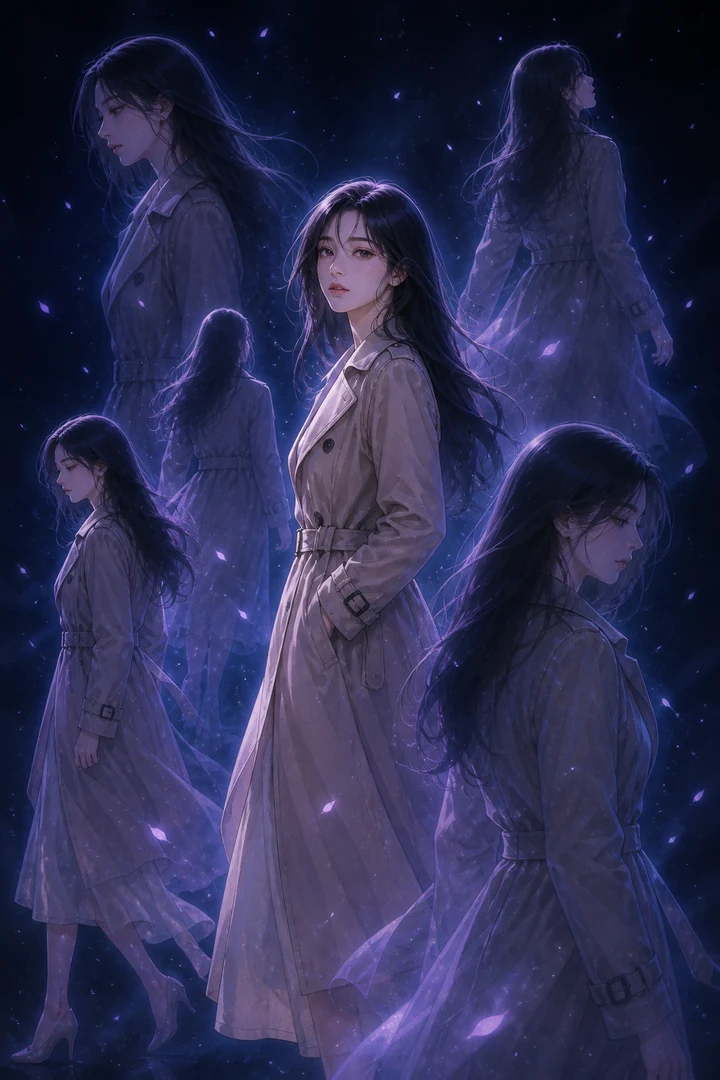
Most people can’t see it. They choose one each day with their eyes closed, and only after choosing do they realize: oh, that wasn’t the path.
There are those who can read that layered flow. They call themselves Observers, and the secret order they gather in is called — Quantarium.
There is, however, one rule.
To observe is to fix.
A future you look into hardens into one the instant you see it. So they never look carelessly, and never speak carelessly.
This is the story of a woman whose two lives collided into one.
Episode 1 — Just My Luck
It was raining.
Of all days, I had left my umbrella behind. That’s always how it goes with me. Whatever I choose, one thing always goes wrong.
Seo Jian, thirty-four. Half a year ago I was over the moon, having made it from Busan to Seoul and landed a job at a company everyone envied.
I still remember the day the acceptance text came. I was at the bus stop in front of Busan Station. I clamped my hand over my mouth to keep from screaming, and that night I ordered pork-and-rice soup and a bottle of soju, alone. Finally, at thirty-three — I chewed on those words again and again. Finally things were working out. Finally, for me too.
I’d earned it. It had taken me twenty years to get there.
I’d been handing out flyers since middle school. In high school it was night shifts at a convenience store and weekends at a gas station. I worked my way through college to pay tuition. Two tutoring gigs, dishwashing at a restaurant, the library at dawn. When my nose bled onto the desk, I stuffed it with tissue and went back to the problem set. At that age other people went traveling. At that age, I counted hourly wages.
There was no one to hold my hand out to. The meals at Grandma’s house weren’t meals, they were debts. That’s what walking on eggshells does. Even when no one says a word, you grow careful about the sound of your own spoon. In that house I learned early: what’s mine, I have to earn. No one else will ever earn it for me.
After graduating I joined a small company in Busan — a supplier making parts for a big Seoul conglomerate. Say the company’s name and nobody knows it; say the conglomerate’s name and everyone does. No holiday bonuses, overtime as a given, and after ten years my pay was barely different from when I started. I stayed anyway. And while I stayed, I sliced up my paycheck and saved some more.
Somewhere in those ten years, an executive sent down from headquarters took notice of me. He’d been posted in Busan for a few months to inspect deliveries. He said he’d seen me reconcile paperwork to the very last line while everyone else just waved it through. Two years after he went back to Seoul, an opening for experienced hires was posted, and he got in touch. Apply, he said. He was the one who opened the door, but I was the one who walked through it. Documents, a written test, three interviews. He wasn’t in the room for any of it.
That was the money I’d saved. A number that grew one line at a time in my bankbook over more than a decade. Money saved by going hungry, by fighting sleep, by bleeding from the nose. I came up to Seoul with that one bankbook, and it became my jeonse deposit — the big lump sum you hand over to rent a place.
Two subway stops from work, an old low-rise apartment that caught plenty of sun. The first room in twenty years where I could lift a spoon without watching anyone’s face. On signing day I sat on the realtor’s sofa and, for the first time in my life, read something called a property register, line by line. Clean, they said. No problems, they said. The man who called himself the landlord smiled like a nice guy and stamped his seal.
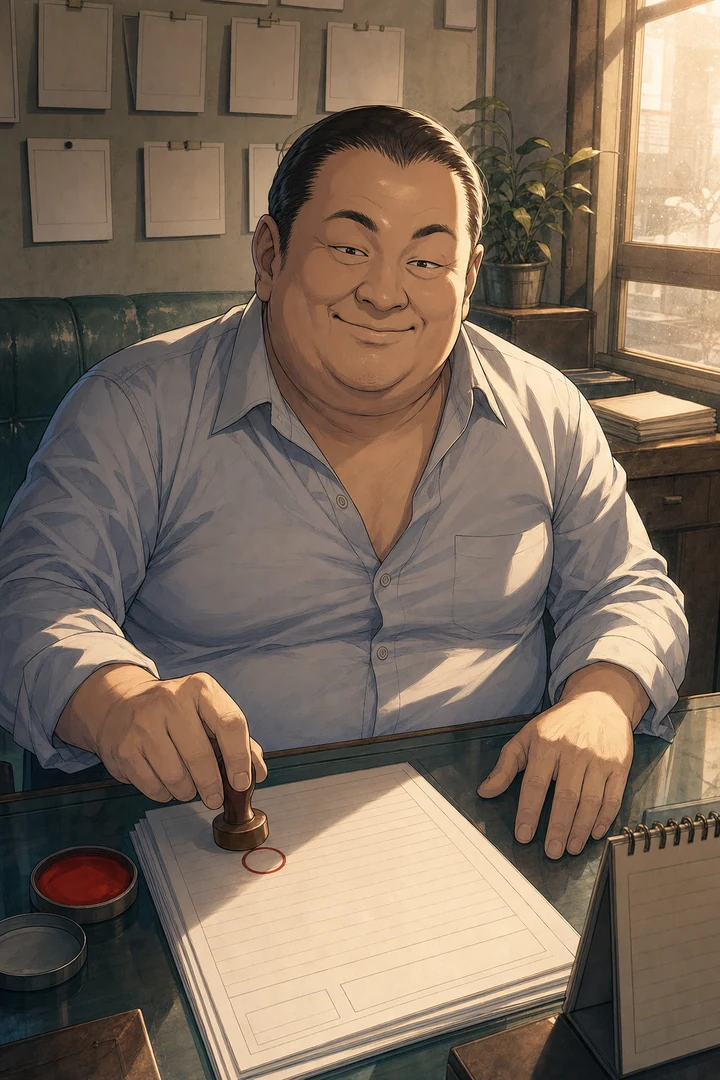
I didn’t know then that the seal was being stamped onto my life.
The landlord wasn’t the landlord. He was a name that existed only on paper, and even the police couldn’t count how many people stood behind that name. In that one building alone, nine households had fallen for the same scam. All of them people like me. People who’d come up from the provinces, who were finally trying to make a life, who’d read a property register for the first time.
The deposit never came back. The lawsuit is ongoing. Ongoing means nothing is happening. My lawyer told me to settle in for the long haul — it could be years. Meanwhile I still had to go to work, and I still needed somewhere to lay my body down.
So what I had left was one cubicle in a gosiwon, a cramped rooming house on the far edge of Seoul. A room without a window.
It was the only place I could move into with no deposit, just myself. The hallway always smelled of someone’s instant ramen, and coughs through the wall sounded like they were in my own room. My belongings: one suitcase and two boxes. Thirty-four years of living, and that was what was left.
The day I went to see the room, the realtor followed me all the way out to the stairs just to warn me.
"These stairs get slippery, so be careful, okay~"
Back then the words didn’t even register. The stairs weren’t the problem. That there was no window, that the walls were paper-thin — none of it mattered. I just needed somewhere to lie down.
And then today. It rained, I had no umbrella, and I was hurrying up those stairs, soaked to the bone.
I’d worked late. By the time I got off the subway I was already drenched, so there was no point running, but my body ran anyway. All I could think was that I wanted to get inside and lie down. Don’t wash, don’t turn on the light, just lie down. Another day was over, somehow.
As I rounded the landing, I crashed into someone.
A young woman, early twenties maybe. There was no time to dodge. Our shoulders slammed together, my wet foot slipped —
The world flipped over.
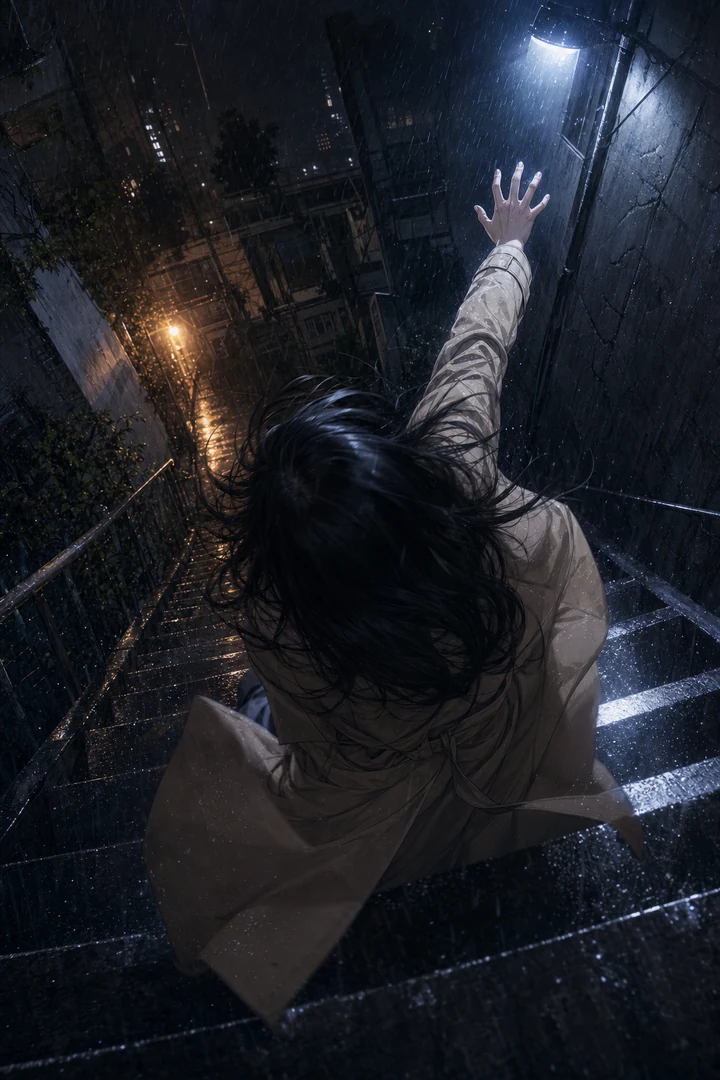
The two of us went tumbling down the stairs in one tangle. The sound of something hitting hard, her scream, cold cement. Down, and down. I remember my hand clawing at the air for something to grab. There was nothing.
In that brief moment as my consciousness faded, strangely, my whole life flashed by.
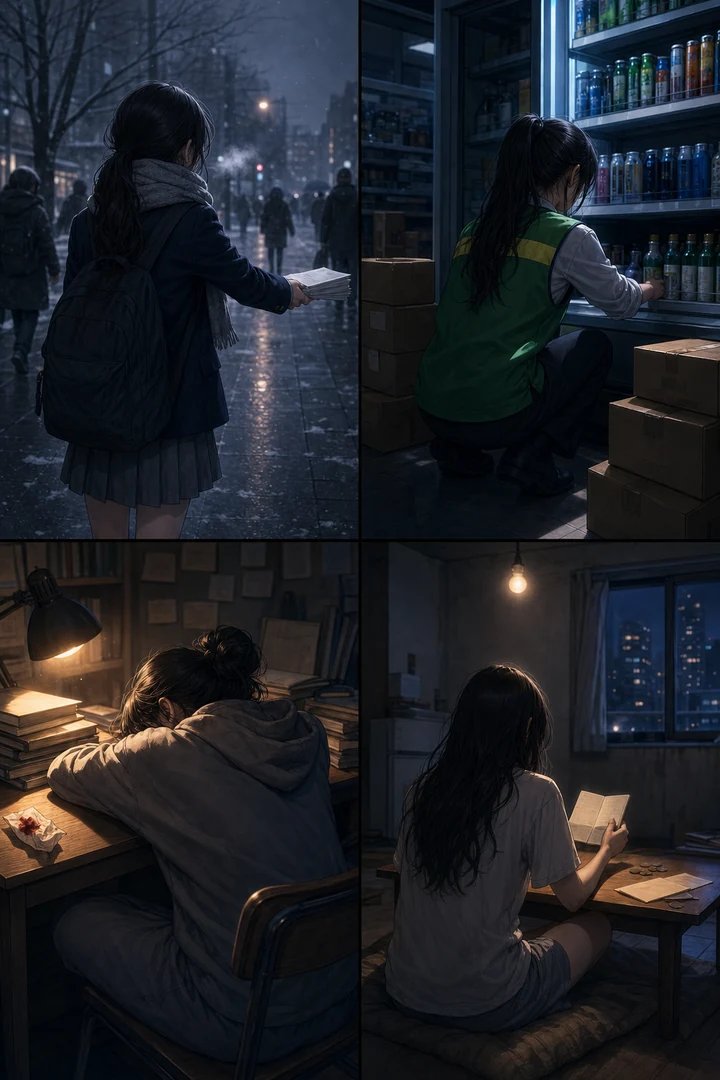
The day my father’s business collapsed. I came home from elementary school to find strange men standing in the living room, and my father on the sofa, staring only at the floor. It was the first time those big shoulders had ever looked so small.
My mother’s back as she packed up and vanished in the night. She had paused for a moment outside my door while I pretended to sleep. I could feel her deciding whether to open it. In the end she didn’t. I kept my eyes shut until her footsteps passed the front door and faded away. That was the last time.
Little me, left at the door of Grandma’s house. Meals eaten while reading the room. Everything I held back. I want this. I want to go. It hurts. Saying them made me a burden, so the first thing I learned was how to swallow them.
Me at eighteen, jolting awake from a doze at a convenience-store counter before dawn. Me at twenty-two, pressing tissue to a nosebleed on a library desk. Me on countless nights, recounting my bank balance again and again.
And still I lived. I clawed my way through. A job I barely managed to grab, a jeonse place I barely managed to secure. The spot where I thought, that’s it, now it finally begins. And the spot where even that disappeared.
Honestly, just my luck.
That was my last thought.
⁎
Ugh, my head.
How long have I been lying here?
My eyelids were heavy. A white ceiling. The smell of disinfectant. Somewhere, the steady beep, beep of a machine. A hospital, I figured.
The stairs. Right, I fell down the stairs. Is that girl okay?
My whole body should have ached like I’d been beaten, but strangely, nothing hurt. Nothing broken, nothing stiff. If anything, my body felt light. Unfamiliarly light. A body that, past thirty, felt heavy even after a full night’s sleep now felt as light as if it were floating on water.
Weird. How much painkiller did they pump into me?
I raised a hand to my forehead. The hair my fingertips touched was soft. Silky. It slipped through my fingers as it fell.
Weird. Did I get a hair treatment lately? Why is my hair so nice?
When was I last at a salon? Has to be half a year. I didn’t want to waste the money, so I just hacked at it myself at home —
Huh?
The moment I brought that hand in front of my eyes, I froze.
Why is my wrist so thin?
It wasn’t my arm. It was pale and slender and smooth, without a single tendon showing. Even the nails were neatly shaped. Pale pink, done with care.
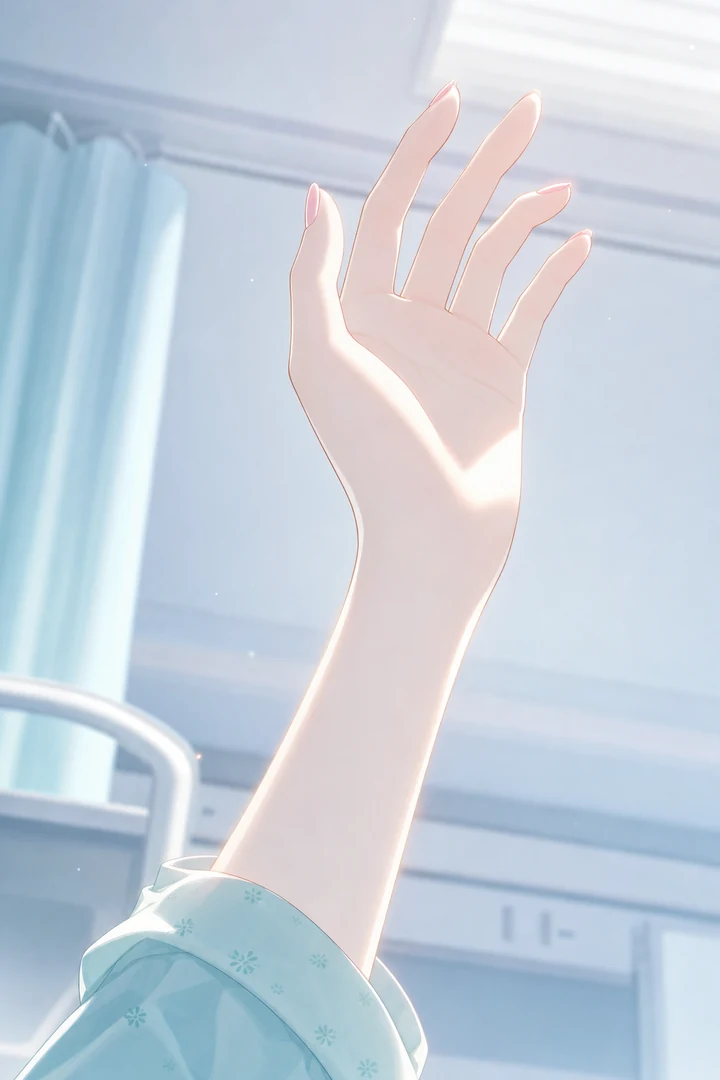
I’ve never grown my nails out. They get in the way when I type. I never had the time to do them, or the money.
My heart dropped.
I shot upright. The IV line in my arm pulled taut. Above the sink in one corner of the room was a small mirror. I staggered toward it. My legs were shaking. Whether from fear or because these legs felt foreign, I couldn’t tell.
In the mirror was some woman.
Young. Dazzlingly pretty. In her twenties. She widened her eyes right along with me.
"Who are you?!"
Even the voice that came out of my mouth was a stranger’s. Clear, and young.
The woman in the mirror screamed the same. When I raised my hand, she raised hers; when I touched my cheek, she touched hers. The cheek was soft. The fingertips touching and the cheek being touched both felt like someone else’s, yet the sensation was mine. It was me. This unfamiliar face was me, now.
My breath came fast. It’s a dream. It had to be a dream. I pinched my cheek. It hurt. I’d heard of dreams so vivid even the pain feels real, but never of a dream that smells of disinfectant.
I thought hard. The stairs. The shoulder I hit. That girl.
It was this face. The very woman I’d crashed into on the stairs yesterday.
We fell together. We must have been brought in together. And yet here I am, looking into the mirror with her eyes. Screaming with her throat.
Then.
"…Then where am I?"
I left the room. I don’t even remember whether I pulled out the IV or dragged it along. I wandered the halls. The floor was cold under my bare feet. A nurse called after me, but I didn’t listen. Ma’am, ma’am — the voice sounded far away, as if heard underwater. My legs moved on their own. As if they knew where to go.
I went up a floor. I don’t know whether I read the signs or not. I just knew. That it was this way.
Intensive Care Unit.
It wasn’t visiting hours, so I couldn’t go in. I pressed myself against the window facing the hallway, almost clinging to it.
Beyond the glass, a single bed. A woman lying with her eyes closed, hooked up to machines. Her hair was dry and brittle, her wrists thick, her face caked with exhaustion. A tube in her mouth, patches stuck to her chest, and the machine’s numbers rising and falling in her place.
Seo Jian.
I didn’t even need to read the name tag hanging at the foot of the bed. It was the face I’d seen in the mirror every day for thirty-four years. A face no one ever called ugly or pretty, only ever told it looked tired. The face I met while washing up every night after working late. That was me. The real me.
The thirty-four-year-old me was lying over there in a coma. With a machine breathing for her.
And yet here I was, standing right here. In someone else’s body. With someone else’s palm pressed against the glass.
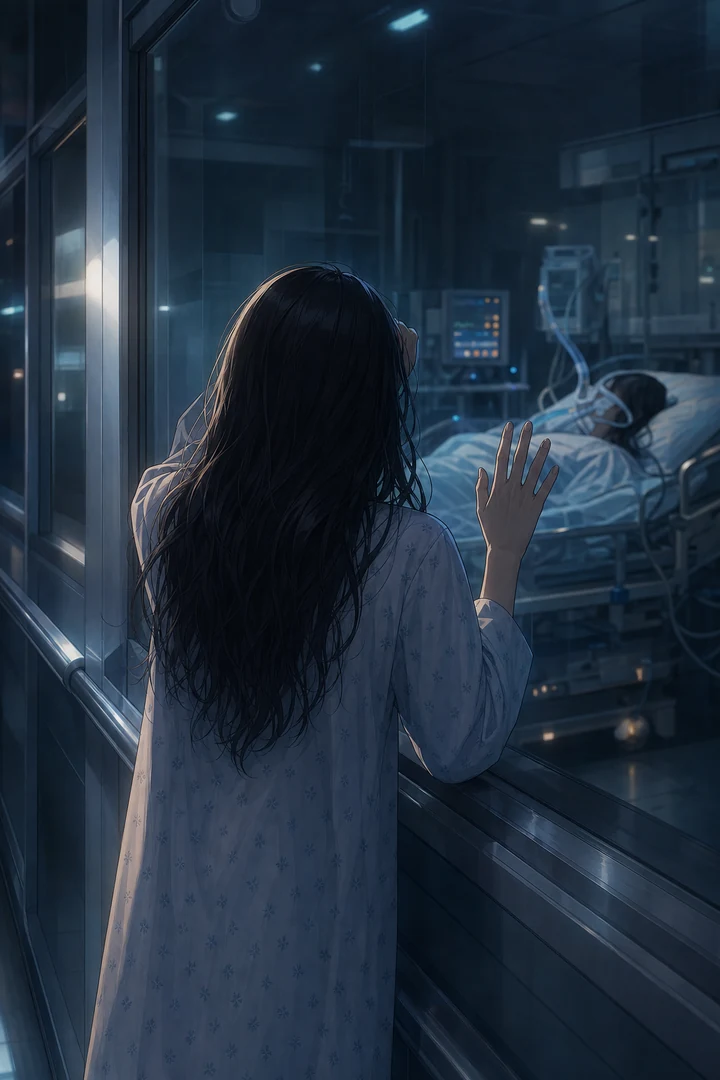
It was strange. I didn’t even cry. My first thought was how pitiful that woman lying there was. Like it was someone else’s problem. That poor woman, what’s she going to do? She was finally trying to make a life. Then, a beat late, it hit me that she was me.
Not dead, and not alive either.
My legs gave out and I leaned against the glass. Something leaked out of me — a laugh or a sob, I couldn’t tell. Yeah. Just my luck. When I lost my deposit, when I fell down the stairs, and even dying — like this, stuck halfway.
Until the nurses rushed over and took me back to my room, I couldn’t tear myself away from that window.
⁎
I don’t remember how I got out of the hospital.
When I came to, I was on a street at night. The rain had stopped at some point. A wind that smelled of rain swept over the wet asphalt. Streetlight pooled in every puddle, so the lights floated in layers on the pavement too.
I walked wherever my feet took me. I didn’t even know where this body lived. I couldn’t go to my gosiwon either — the key to that room would be in the bag of the woman lying in the ICU. Having nowhere to go, I was used to. Having no body to go back to was a first, and laughter kept leaking out of me.
Two passersby glanced back at me. At first I thought it was because I looked a mess. It took me a while to get it. They were looking because this face was pretty. In thirty-four years I had never once gotten that kind of look. And now, of all times. I wasn’t happy about it at all.
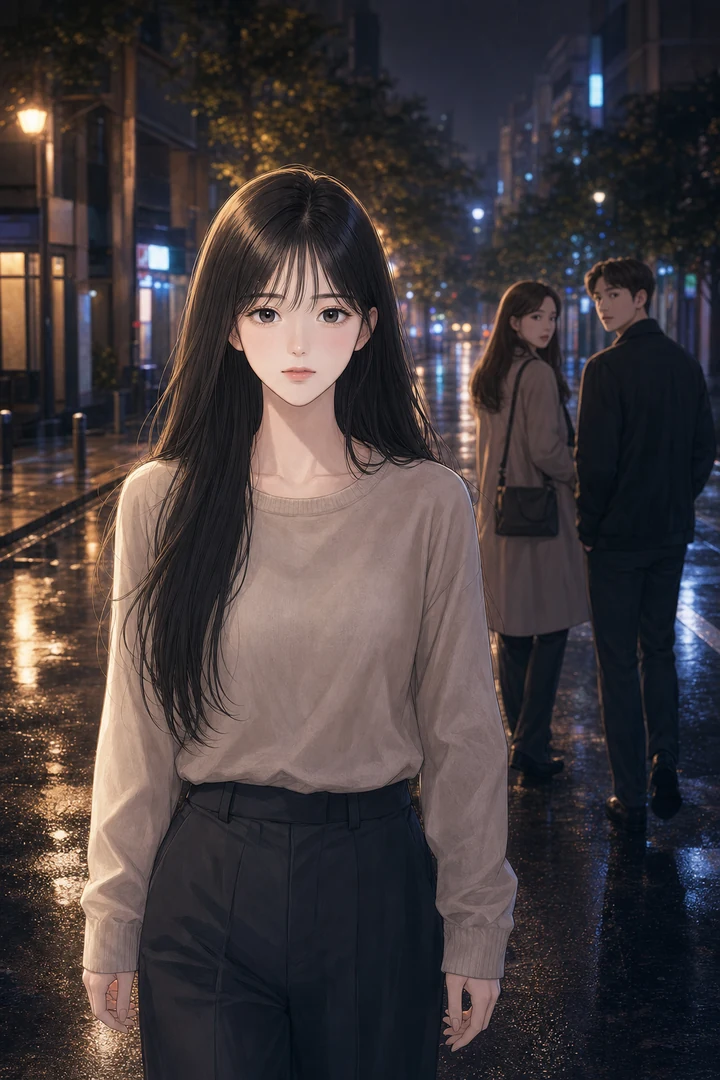
How long did I walk?
It was the street I always took. The corner between the gosiwon and the subway station, the one I’d passed twice a day for half a year. That blank wall between the convenience store and the closed-down dry cleaner.
And at that corner was a door that definitely hadn’t been there yesterday.
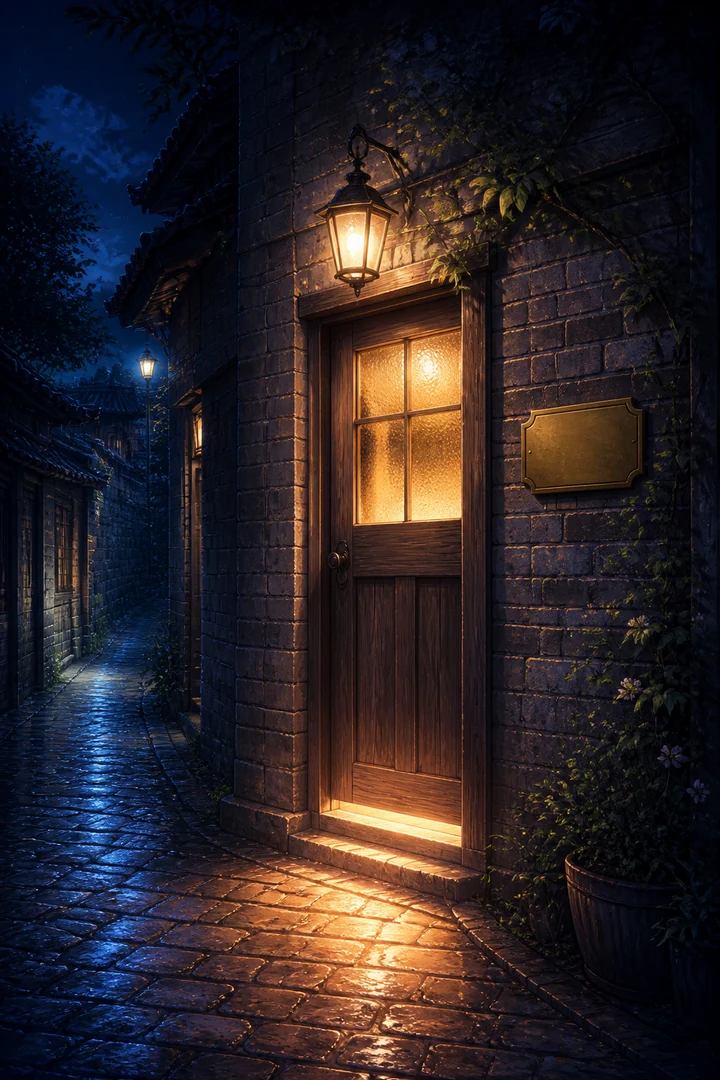
An old wooden door. Above it, a brass sign no bigger than a palm. Warm-colored light seeped thinly through the gap. None of the passersby looked at that door. They walked right past it without a single glance. As if no one could see it but me.
The sign read:
QUANTARO.
A name I didn’t even understand. And yet, strangely, I felt that if I went there I might learn something. Why I’d ended up like this. How I could go back.
I had no reason to think so. But for someone neither dead nor alive, I was in no position to demand reasons.
On unfamiliar legs, I began walking toward that door.
(End of Episode 1)